

Online therapy for depression is talk therapy delivered by secure video with a licensed provider, and it can use the same evidence-based approaches as in-person care, such as cognitive behavioral therapy (CBT) and interpersonal therapy. The National Institute of Mental Health (NIMH) lists both as evidence-based treatments for depression. To choose well, look at the approach, the provider’s license, how visits work and whether the fit feels right. Mind & Body Wellness offers online therapy for depression in North Carolina and Florida.
Depression is a medical condition, and reaching out for help is a strong, caring step. If your days are packed with work, kids or caregiving, or the nearest therapist is a long drive away, online therapy for depression can make that first step easier. You don’t need to travel, sit in a waiting room or explain an absence to anyone. Here’s how the main types of therapy work, what sessions feel like and how to choose an online therapist you trust.
Online therapy for depression uses video sessions with a licensed therapist. Common approaches include cognitive behavioral therapy (CBT), interpersonal therapy and behavioral activation. The right choice depends on your symptoms, your goals and how comfortable you feel with the therapist. Many people begin with therapy alone, and some add medication, which a prescriber decides with you. Every person’s path is different.
What Is Online Therapy for Depression?
Online therapy for depression is talk therapy delivered through secure video with a licensed mental health professional. You meet at scheduled times, work on goals together and check in on how you feel over time, all from a private space you choose.
Depression is more than a bad week. It can affect mood, sleep, energy, appetite and focus. It’s common, it’s treatable and it’s nothing to be ashamed of. Therapy gives you a steady place to understand what’s happening and to build skills that help.
For many people, online care removes the barriers that delay treatment. There’s no commute and no waiting room, and sessions can fit around work or family. That convenience makes it easier to start and to keep going.
Key Takeaways
- Online therapy for depression uses the same evidence-based approaches as in-person care, including CBT and interpersonal therapy, and depression treatment online follows the same steps.
- Behavioral activation is a structured approach that links small, planned activities to mood.
- Choose a therapist by license, approach, experience with depression and how heard you feel.
- For milder depression, treatment may begin with therapy alone. For moderate or severe depression, NIMH notes that many professionals recommend therapy and medication together.
- You’re always welcome to switch to a different online therapist if the fit doesn’t feel right.
- If you’re thinking about suicide, call or text 988 right away. For immediate danger, call 911.
Which Types of Therapy Are Used for Depression?
NIMH states that evidence-based therapies for depression include cognitive behavioral therapy and interpersonal therapy, and that other forms, such as psychodynamic therapy used for a limited time, may help some people. A good therapist explains the approach in plain language and adjusts it to you.
|
Wondering which approach could fit you? Our team at Mind & Body Wellness helps you talk through your symptoms and goals with a licensed provider, so your care plan starts from what matters to you. |
Cognitive behavioral therapy (CBT)
NIMH describes CBT as a way to learn to challenge and change unhelpful thoughts and behaviors. For example, you and your therapist might notice a thought like “I always let people down,” test it against real events and practice a more balanced view. CBT often includes simple skills you can try between sessions.
Interpersonal therapy (IPT)
Interpersonal therapy looks at how relationships and life events affect your mood, and how your mood affects your relationships. It can be a helpful fit when low mood follows a loss, a conflict or a big change such as a new job or a move.
Behavioral activation
Behavioral activation helps you plan small, meaningful activities, even when motivation is low. Research reviews describe it as a structured approach built on the link between activity and mood. The idea is to act first, in small steps, rather than wait until you feel ready. The approaches listed on our team page include CBT and Acceptance and Commitment Therapy (ACT), so your therapist can match a style to your needs.
| Approach | Main focus | May fit when |
| Cognitive behavioral therapy | Unhelpful thoughts and behaviors | You want practical skills to try between sessions |
| Interpersonal therapy | Relationships and life changes | Low mood connects to loss, conflict or a transition |
| Behavioral activation | Small, planned activities | Low energy and withdrawal make daily life feel stuck |
These approaches overlap, and many therapists blend them. You don’t have to pick one on your own. Your therapist can suggest a starting point and adjust as you go.
Other approaches you may hear about
You may also hear about psychodynamic therapy, which looks at patterns from the past, and Acceptance and Commitment Therapy, which helps you act on your values even when hard feelings show up. If a name is unfamiliar, ask your therapist to explain it in everyday words. A clear explanation is part of good care.
How Does Online Therapy for Depression Work Step by Step?
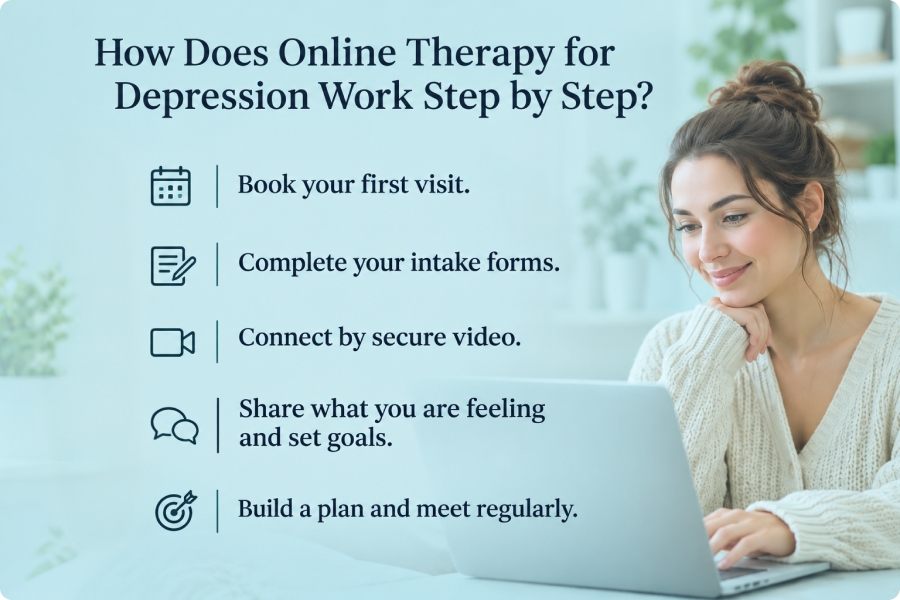
The process is simple and designed to feel comfortable. Here’s how online therapy for depression usually begins at Mind & Body Wellness.
- Book your first visit. Call or send a message to schedule an appointment. Same-week appointments are typically available for new patients.
- Complete your intake forms. After booking, intake forms arrive by email. Completing them early gives your provider your health history before you meet.
- Connect by secure video. At your appointment time, click the secure video link on your phone, tablet or computer. No special app is needed.
- Share what you are feeling and set goals. Talk about your mood, sleep, daily life and what you hope to change. Your provider listens and explains possible approaches.
- Build a plan and meet regularly. You and your provider agree on a care plan and a schedule. You can adjust the plan as your needs change.
You can learn more about our mental health therapy services, including depression treatment online in Florida and a therapist in North Carolina, or read what to expect in our guide to a first telehealth therapy session.
What a session feels like
A session is a conversation. You talk, your therapist listens, asks questions and may suggest a skill to practice. Your therapist may ask about your mood, sleep and daily routine so you can both see patterns. You set the pace, and you can ask questions at any time.
|
Ready to begin depression treatment online? Our team at Mind & Body Wellness helps adults, teens and children meet with a licensed provider by secure video, from a place that feels comfortable to you. |
How Do You Choose the Right Online Therapist?
The relationship with your online therapist for depression matters as much as the method, so take your time with this choice. Look at these areas:
- License: Make sure the online therapist is licensed to practice in your state during the visit, whether that’s North Carolina or Florida. Common licenses include clinical social worker and clinical mental health counselor.
- Approach: Ask which methods the therapist uses for depression and why.
- Experience: Ask how often the therapist works with people who have depression.
- Fit: Notice whether you feel heard and respected. A good fit often matters more than a perfect resume.
- Practical details: Check scheduling, insurance and how the video link works.
- Continuity: Seeing the same provider each time helps your therapist learn your history.
Questions to ask on a first call
- What types of therapy do you use for depression?
- What will our first session look like?
- How will we track whether therapy is helping?
- How do we handle a crisis between sessions?
- What if we decide another approach would suit me better?
How you’ll know you’ve found a good fit
- You leave sessions feeling listened to and respected.
- You understand the plan and the reason behind it.
- You feel comfortable being honest.
- Your questions about the approach are welcomed.
If you’d like something different, say so. Adjusting the approach or finding a different provider is a normal part of getting the right support.
Can Therapy and Medication Work Together?
Sometimes. NIMH notes that treatment for milder depression might begin with psychotherapy alone, with medication added if symptoms continue, while for moderate or severe depression many professionals recommend therapy and medication together. Whether medication makes sense is a decision for you and a prescriber, such as a psychiatric nurse practitioner. Our medication management visits cover evaluation and follow-up.
Please don’t start, stop or change any medicine without speaking to your prescriber. Many people feel nervous about this conversation, and it helps to write your questions down beforehand: what to expect, how follow-up works and what other supports can go alongside treatment, so you walk in prepared and relaxed. Your provider will talk through your options and answer every question.
|
Looking for support that fits your schedule? Our team at Mind & Body Wellness helps you start therapy from home, with a licensed provider who learns your story and sees you again each visit. |
A Made-Up Example: Starting Online Therapy
This example is fictional and shows the process. It isn’t a real patient or a real case.
Picture Jordan, who has felt flat and tired for months. Jordan stopped seeing friends and has trouble finishing work tasks. Jordan books a first visit, completes the intake forms and connects by video from the living room.
In the first session, the therapist listens, asks about sleep, mood and daily routine, and explains a few approaches. Together they choose to start with small, planned activities and a simple way to notice unhelpful thoughts. Jordan leaves with one small task and a next appointment.
How Can You Get the Most From Online Therapy?
- Pick a private space. Headphones help if others are nearby.
- Keep a steady schedule. Regular sessions help you build momentum.
- Be honest. Your therapist is there to help, not to judge.
- Practice between sessions. Small skills add up over time.
- Speak up about fit. It’s okay to ask for a different approach or a different therapist.
Protecting your privacy
Mind & Body Wellness uses HIPAA-compliant secure video, and your health information is shared only as the law allows, and in most other cases only with your written consent. Telehealth.HHS.gov, a federal resource, also suggests using your own device, avoiding public Wi-Fi and turning off voice assistants or home cameras during a visit.
What Signs Suggest It May Be Time to Reach Out?
Depression looks different for everyone, and some people notice it in seasonal patterns. Consider reaching out if you notice several of these and they last or keep coming back:
- Low or empty mood on most days.
- Loss of interest in things you used to enjoy.
- Changes in sleep, appetite or energy.
- Trouble focusing or making decisions.
- Feelings of guilt, worthlessness or hopelessness.
Your primary care provider can also be part of your support team, since sleep, energy and physical health all affect mood. Anxiety often travels with low mood, so see our online anxiety treatment guide too.
What Should You Do If You Need Support Right Now?
Online therapy is for ongoing support, not emergencies. If you’re thinking about suicide or feel unsafe, call or text 988 to reach the 988 Suicide & Crisis Lifeline, available around the clock. If there’s immediate danger, call 911. You don’t have to wait for an appointment to ask for help.
Conclusion
Online therapy for depression gives you a private, flexible way to get support from a licensed professional, and online depression treatment can begin with a single call. Learn the main approaches, choose an online therapist who listens and take the first step at your own pace. Support is available, and you don’t have to carry this alone.
Mind & Body Wellness provides fully virtual mental health care across North Carolina and Florida, with providers who see you at every visit. When you’re ready, send us a message and we’ll help you schedule a first visit.
This article is for educational purposes only and is not medical advice. It does not diagnose or treat any condition. If you are in crisis, call or text 988, or call 911 in an emergency.
FAQs
What is online therapy for depression?
Online therapy for depression is talk therapy delivered by secure video with a licensed professional. It can use approaches such as CBT, interpersonal therapy and behavioral activation. You attend from a private space that you choose.
Is online therapy as effective as in-person therapy?
Many people find online therapy helpful, and the approaches are the same. Results vary by person, and no one can promise a specific outcome. Our article on telehealth and in-person therapy explores this question in more detail.
How do I find depression treatment online?
For depression treatment online, look for licensed providers who offer video visits, check that they treat depression and confirm how they handle insurance. Then book a first visit to see whether the fit feels right. You can change providers at any time.
Do I need medication for depression?
Not always. NIMH notes that treatment for milder depression might start with therapy alone, while moderate or severe depression is often treated with therapy and medication together. A prescriber decides with you and doesn’t start or change medicine without your input.
How do I choose an online therapist?
To choose an online therapist, check the license, ask about experience with depression, learn which methods the therapist uses and notice whether you feel heard. Seeing the same provider each visit also helps.
Is online therapy private?
Providers that follow HIPAA must protect your health information. Mind & Body Wellness uses HIPAA-compliant secure video. You can add privacy by choosing a quiet space, using headphones and avoiding public Wi-Fi.
What if I need help right away?
Call or text 988 at any time, or call 911 if you’re in immediate danger. Online therapy isn’t an emergency service, and you don’t need to wait for a scheduled visit to get help.
Read More About Depression and Online Care
- Telehealth for Depression: What an Online Evaluation Looks Like – how an online depression evaluation works
- Seasonal Depression: Signs, Treatment, and When to Get Help – signs that mood changes follow the seasons
- What Happens During Your First Telehealth Therapy Session? – a walk through your first video visit
Sources
- Depression – National Institute of Mental Health (https://www.nimh.nih.gov/health/publications/depression)
- Behavioural activation therapy for depression in adults with non-communicable diseases – PubMed Central (https://pmc.ncbi.nlm.nih.gov/articles/PMC8094508/)
- How do I protect my data and privacy? – Telehealth.HHS.gov (https://telehealth.hhs.gov/patients/additional-resources/data-privacy)
- 988 Suicide & Crisis Lifeline – SAMHSA (https://www.samhsa.gov/mental-health/988)
