

Important Notice: This article is for informational purposes only and does not constitute medical advice. If you believe you are experiencing a psychiatric emergency, please call 911 or go to your nearest emergency room immediately.
Key Takeaways
- PTSD is a mental health condition that can develop after experiencing or witnessing a traumatic event, affecting people of all backgrounds.
- Telehealth mental health services deliver effective PTSD treatment, including therapy and medication management, without requiring in-person visits.
- Evidence-based treatments like Cognitive Processing Therapy and Prolonged Exposure therapy are fully available through secure virtual appointments.
- Patients in rural areas of North Carolina, Florida, and Virginia can access licensed psychiatric providers without long-distance travel.
- Mind & Body Wellness PLLC offers same-week telehealth appointments for PTSD evaluation and ongoing treatment across NC, FL, and VA.
You’ve been through something difficult. Maybe it was years ago. Maybe it still feels like yesterday.
For millions of Americans, traumatic experiences don’t stay in the past. They show up in nightmares, in sudden panic, in the way certain sounds or smells send your body into a state of high alert. That’s PTSD – and it’s far more common than most people realize.
According to the U.S. Department of Veterans Affairs, roughly 6 percent of the U.S. population will experience PTSD at some point in their lives. That’s about 20 million people. And yet many of them never get treatment – often because accessing mental health care feels too complicated, too far away, or too uncomfortable.
That’s exactly what telemedicine services are changing. In this article, we’re walking through what PTSD actually is, how it’s diagnosed, and how virtual treatment through licensed providers is making a real difference for patients across the country.
What is PTSD?
What Causes PTSD and Who Is at Risk
PTSD doesn’t discriminate. It affects veterans, first responders, survivors of accidents, people who experienced childhood trauma, and anyone who has faced a situation where they felt their life or someone else’s was in danger.
Some of the most common triggers include:
- Military combat or active duty service
- Physical or sexual assault
- Serious accidents or medical emergencies
- Natural disasters like hurricanes or floods
- Sudden loss of a loved one
- Witnessing violence or traumatic events
Not everyone who experiences trauma develops PTSD. Research suggests that individual factors like support systems, prior trauma history, and biology all play a role. But the absence of timely mental health support is one of the clearest risk factors for PTSD becoming a long-term condition.
For patients across rural areas in particular – where mental health providers are scarce and wait times stretch for months – access to virtual primary care in Florida and telehealth mental health services can be the difference between getting help and suffering in silence.
What are the risk factors for developing PTSD?
Risk factors for PTSD include previous trauma exposure, lack of social support, pre-existing anxiety or depression, and the severity of the traumatic event. Women are diagnosed with PTSD at higher rates than men, according to the National Institute of Mental Health. Military veterans carry a particularly high burden, with the VA estimating that PTSD affects between 11 and 20 percent of those who served in recent conflicts.
Common Symptoms of PTSD
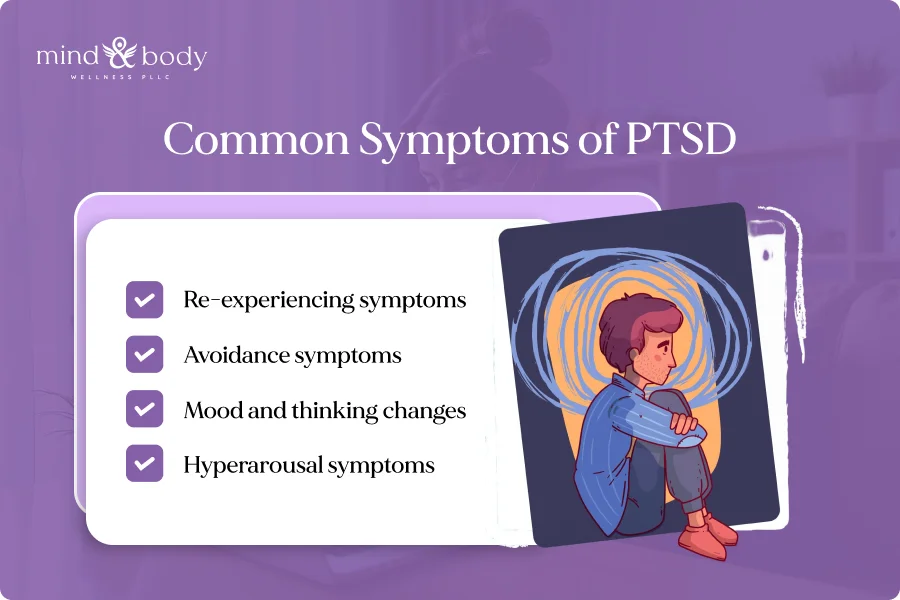
Recognizing PTSD can be harder than it sounds. Symptoms often develop weeks or months after a traumatic event and can look different from person to person.
The four main symptom categories include:
Re-experiencing symptoms
- Flashbacks that feel intensely real
- Nightmares related to the traumatic event
- Intrusive memories that arrive without warning
- Intense emotional or physical reactions to reminders of the trauma
Avoidance symptoms
- Avoiding thoughts, feelings, or conversations about the event
- Staying away from places, people, or activities that are reminders
- Emotional numbness or feeling detached from others
Mood and thinking changes
- Persistent negative beliefs about yourself or the world
- Difficulty feeling positive emotions
- Ongoing feelings of guilt, shame, or blame
- Loss of interest in activities that previously brought enjoyment
Hyperarousal symptoms
- Feeling constantly on edge or easily startled
- Sleep difficulties and insomnia
- Irritability or angry outbursts
- Difficulty concentrating
If you’ve been experiencing several of these symptoms for more than a month following a traumatic event, speaking with a licensed mental health provider is an important next step. A primary care provider with mental health expertise can help assess what you’re experiencing and determine the most appropriate path forward.
Think you might be experiencing PTSD symptoms?Mind & Body Wellness PLLC offers telehealth mental health evaluations for patients across North Carolina, Florida, and Virginia. You can connect with a licensed provider from home without a long wait. |
How PTSD Is Diagnosed
PTSD is diagnosed by a licensed mental health professional using criteria from the DSM-5 (Diagnostic and Statistical Manual of Mental Disorders, Fifth Edition). A clinical evaluation involves reviewing your symptoms, how long they’ve been present, whether they’re affecting your daily functioning, and ruling out other conditions that may look similar.
There’s no blood test or brain scan for PTSD. The diagnosis comes from a thorough clinical interview, which can happen just as effectively through a secure video appointment as it can in a physical office.
How long does it take to get diagnosed with PTSD?
A PTSD evaluation typically takes one to two appointments with a licensed mental health provider. The first appointment usually involves a detailed clinical interview covering your trauma history, current symptoms, and daily functioning. A second session may be needed to clarify the diagnosis and discuss treatment options. At Mind & Body Wellness PLLC, initial appointments are 45 to 60 minutes and can be scheduled via telehealth within the same week in many cases.
PTSD Treatment Options Available Through Telehealth
The good news is that PTSD responds well to treatment. Most people who engage consistently with evidence-based care see meaningful improvement in their symptoms.
The most effective treatment approaches include:
Cognitive Processing Therapy (CPT)
CPT helps you examine and reframe the unhelpful beliefs that developed because of your trauma. It’s typically delivered over 12 structured sessions and has strong research backing from the American Psychological Association as a first-line PTSD treatment.
Prolonged Exposure Therapy (PE)
PE involves gradually and safely confronting trauma-related memories and situations you’ve been avoiding. It works by helping your nervous system learn that these memories, while painful, are not dangerous in the present moment.
EMDR (Eye Movement Desensitization and Reprocessing)
EMDR uses bilateral stimulation – often eye movements – while you focus on traumatic memories. It’s recognized by the World Health Organization as an effective treatment for PTSD and has been adapted for telehealth delivery.
Medication management
Certain medications – particularly SSRIs like sertraline and paroxetine – are FDA-approved for PTSD treatment. A psychiatric provider can evaluate whether medication is appropriate for your situation and manage your prescriptions through telehealth. At Mind & Body Wellness PLLC, prescriptions are sent electronically to your local pharmacy the same day when clinically appropriate.
Combined therapy and medication
For many patients, the most effective approach combines psychotherapy with medication management. Both components are available through our mental health services via telehealth.
Also Worth Knowing: If you’re also managing depression alongside PTSD, depression treatment online Florida through the same provider can address both conditions within a single, coordinated care plan.
How Telehealth Delivers PTSD Care in NC, FL, and VA
One of the most persistent barriers to PTSD treatment has always been access. Patients in rural counties, those without reliable transportation, veterans who avoid crowded waiting rooms, and working adults who can’t take time off mid-week have all historically been underserved.
Telehealth Florida and broader telehealth services across the Southeast have significantly shifted that dynamic. Virtual appointments mean:
- No travel required – you connect from wherever you are
- No waiting rooms – which can be a real barrier for people with hyperarousal symptoms
- Consistent access to the same provider at every visit
- Flexible scheduling, including evening availability
- HIPAA-compliant video sessions that protect your privacy
Mind & Body Wellness PLLC serves patients across North Carolina, Florida, and Virginia. For patients seeking mental health services, Virginia residents can access, or those in rural NC or FL communities, telehealth removes the geographic barrier entirely.
Is telehealth effective for PTSD treatment specifically?
Yes. Multiple peer-reviewed studies have found that telehealth delivery of evidence-based PTSD therapies, including CPT and PE, produces outcomes comparable to in-person treatment. A 2018 study published in JAMA Psychiatry found that CPT delivered via video was as effective as in-person CPT for veterans with PTSD. The American Psychological Association supports telehealth as a legitimate and effective modality for trauma-focused treatment.
|
Want to speak with a licensed provider about PTSD treatment options? Our clinical team at Mind & Body Wellness PLLC includes licensed psychiatric NPs and therapists who specialize in trauma-informed care. Appointments may be available within the same week. |
What to Expect at Your First Virtual PTSD Appointment
Knowing what happens during your first telehealth mental health visit can make it feel less daunting. Here’s how the process generally works at Mind & Body Wellness PLLC.
Step 1: Book your appointment
Call (910) 387-3840 or book online. Same-week appointments are often available for new patients in NC, FL, and VA.
Step 2: Complete intake forms
After booking, you’ll receive intake forms by email. These cover your health history, current symptoms, and any medications you’re taking. Completing these before your appointment means your provider comes prepared.
Step 3: Connect via secure video
At your appointment time, click the HIPAA-compliant video link sent to your email. You can connect from your phone, tablet, or computer. No special app required.
Step 4: Clinical evaluation
Your provider conducts a thorough assessment of your symptoms, trauma history, and daily functioning. This is a conversation, not an interrogation. You’re in control of what you share and when.
Step 5: Care plan and next steps
By the end of your appointment, you’ll have a clear picture of your diagnosis, recommended treatment approach, and next steps. If medication is appropriate, your prescription is sent to your pharmacy the same day.
If you’re looking for online therapy for depression alongside PTSD treatment, or need behavioral health urgent care support between scheduled appointments, our team can help coordinate both within your care plan.
Does insurance cover telehealth PTSD treatment?
Yes, in most cases. Mind & Body Wellness PLLC accepts Aetna, Cigna, Florida Blue, Medicare, and Medicaid, among more than 30 insurance plans. Most major insurers cover telehealth mental health services, including PTSD therapy and psychiatric medication management at standard copay rates. Call (910) 387-3840 or visit our service areas page to verify your specific plan before your first appointment.
Final Thoughts: Getting PTSD Support Without Waiting
PTSD is a serious condition. But it’s also a treatable one. And you don’t have to drive across the state or wait months on a waitlist to access that treatment.
Telehealth has made it possible to connect with licensed psychiatric providers and therapists from home, on a schedule that works for you, with the same clinical standards as in-person care. For patients in North Carolina, Florida, and Virginia – including those in rural communities far from specialist services – this matters enormously.
Mind & Body Wellness PLLC has been providing virtual mental health care since 2020. Our licensed team, led by founder Leistey Tindall, FNP-BC PMHNP-BC, delivers evidence-based PTSD treatment through a practice that prioritizes consistent care from the same provider at every visit.
If you’re ready to take the next step, we’re here. Call (910) 387-3840 or book your telehealth appointment online. New patient appointments are often available within the same week.
This article is for informational purposes only. Always consult a qualified, licensed healthcare provider for diagnosis and treatment. In an emergency, call 911 or go to your nearest emergency room.
