

Important Notice: This article is for informational and educational purposes only. It does not constitute medical advice. Please speak with a licensed healthcare provider before starting, changing, or stopping any treatment for opioid use disorder.
Key Takeaways
- Suboxone (buprenorphine/naloxone) is FDA-approved and significantly reduces opioid cravings and withdrawal without producing a meaningful high.
- Federal regulations now allow licensed providers to prescribe buprenorphine via telehealth without a prior in-person visit.
- Medication-assisted treatment improves survival rates, increases treatment retention, and supports long-term recovery from opioid use disorder.
- Virtual MAT removes common barriers to care, including stigma, distance, and scheduling conflicts.
- Mind & Body Wellness PLLC provides confidential Suboxone telehealth for patients across North Carolina and Florida, with most major insurance accepted.
Most people who reach out about Suboxone aren’t doing it on a whim. They’ve already been thinking about it for weeks. Maybe months. They’ve probably looked it up before, closed the tab, and told themselves they’d figure it out later.
If that sounds familiar, you’re not alone. And the fact that you’re reading this now matters.
Opioid use disorder affects millions of Americans across every state, profession, income level, and background. And one of the biggest reasons people don’t get treatment isn’t that they don’t want it. It’s that getting treatment feels hard. Clinics have wait times. Appointments mean missing work. Walking through a door in a small town means people see you.
That’s exactly why medication-assisted treatment via telehealth has changed so much for so many people. You can now get a full evaluation, a Suboxone prescription, and ongoing care from home. No waiting rooms. No one recognizes your car in the parking lot.
In this article, you’ll learn how telehealth Suboxone treatment actually works, what to expect during the process, how it compares to other MAT options, and what questions to ask before you start. By the end, you’ll know exactly what your next step looks like.
What is Medication-Assisted Treatment (MAT)?
Why So Many People Are Turning to Telehealth for Opioid Treatment
Here’s something worth understanding about opioid use disorder. It often starts in the most ordinary ways.
A surgery. A back injury. A prescription for pain that worked exactly as intended until the day it didn’t. By the time someone recognizes what’s happening, they’re already managing withdrawal every time a dose wears off. The decision to get help doesn’t arrive dramatically. It usually arrives quietly, on an ordinary Tuesday, when the gap between where you are and where you want to be feels too wide to ignore.
Getting opioid addiction treatment used to mean finding a clinic, getting on a waitlist, and physically showing up in a place that carries a lot of stigma. For people in rural parts of the South, including much of North Carolina, that clinic might be over an hour away. For working adults with kids at home, the idea of taking half a day off every two weeks for a refill visit isn’t realistic.
Telehealth changed math. Under federal regulations updated in 2023, licensed and credentialed providers can now prescribe buprenorphine via telehealth without requiring an initial in-person visit. That’s a meaningful change. It means that someone in a small town in eastern North Carolina who would never drive to a city clinic can now speak to a licensed provider over video, get an evaluation, and receive a Suboxone prescription sent directly to their local pharmacy.
That same access applies to patients across Florida. Whether you’re in Jacksonville, Pensacola, or a quiet rural county with limited local options, online suboxone treatment in Florida is now a realistic path to care.
Not sure if telehealth MAT is the right fit for your situation?We’re happy to answer your questions before you book anything. |
What is medication-assisted treatment and how does it help with opioid addiction?
Medication-assisted treatment combines FDA-approved medications like buprenorphine with counseling and behavioral support to treat opioid use disorder. MAT works by reducing cravings and managing withdrawal, giving patients stability to engage in recovery. Research published by SAMHSA consistently shows MAT improves survival rates, increases treatment retention, and decreases illicit opioid use.
How Suboxone Works and Why It’s Not “Just Another Drug”
This is the question we hear most often. And it’s worth answering directly.
Suboxone is not trading one addiction for another. That’s one of the most persistent myths about MAT, and it stops people from getting help that actually works.
Suboxone is the brand name for buprenorphine/naloxone. It has two components that do two different things.
Buprenorphine is a partial opioid agonist. It binds to the same receptors in the brain that opioids bind to, which is why it reduces withdrawal symptoms and quiets cravings. But because it’s a partial agonist, it produces very limited euphoria, especially in patients who have built up opioid tolerance. It calms the brain’s demand for opioids without delivering the high that drives the cycle of addiction.
Naloxone is included specifically to block misuse. If the medication is dissolved and injected rather than taken as directed, the naloxone triggers withdrawal. It’s a safety mechanism built into the medication itself.
Together, these two components give patients something that’s genuinely hard to find during active opioid use. Stability. The ability to wake up, go to work, show up for people who depend on them, and engage with the behavioral support that leads to lasting recovery.
According to SAMHSA’s national treatment guidelines, buprenorphine treatment for opioid use disorder has been shown to:
- Increase rates of patient survival
- Improve retention in treatment programs
- Reduce unlawful opioid use during treatment
- Decrease opioid-related criminal activity
- Improve employment outcomes for patients in recovery
Treating opioid use disorder with Suboxone is no different from treating high blood pressure with medication or depression with an antidepressant. It’s a medical condition being treated with the tools that medicine has developed for it. There is no judgment attached to that.
Read More About: Opioid Addiction Treatment: How Telehealth Makes Recovery More Accessible
Can you get Suboxone via telehealth without seeing a doctor in person?
Yes. Under federal regulations effective since 2023, DEA-credentialed providers can evaluate and prescribe buprenorphine via telehealth without a prior in-person visit. A licensed provider conducts your full assessment by video, and the prescription is sent electronically to your pharmacy. No clinic visit is required to begin buprenorphine telehealth treatment NC and FL.
What MAT Treatment Online Actually Looks Like Step by Step
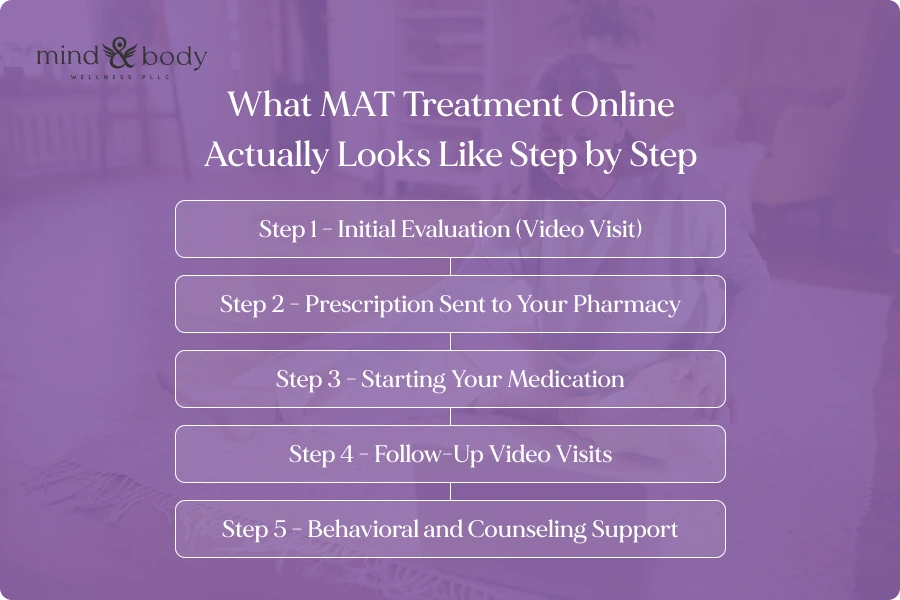
People often think telehealth addiction treatment is a shortcut or somehow less thorough than an in-person program. It isn’t. The clinical process is the same. What changes is where it happens.
Here’s exactly what the process looks like when you start medication-assisted treatment through a telehealth provider like Mind & Body Wellness PLLC.
Step 1 – Initial Evaluation (Video Visit)
Your provider reviews your full health history, current substance use, any previous treatment you’ve had, and what your goals are. This visit typically runs 45 to 60 minutes. It’s thorough, and it should be. Your provider needs to understand your situation before developing a treatment plan.
Step 2 – Prescription Sent to Your Pharmacy
If buprenorphine/naloxone is the right fit for you, your provider sends the prescription electronically to your preferred pharmacy. You pick it up the same way you would any other medication. No special clinic. No identifying signage.
Step 3 – Starting Your Medication
Your provider will guide you on timing. Most patients begin Suboxone when they’re already in mild to moderate withdrawal, because that’s when buprenorphine is most effective and most comfortable to start. Your provider explains exactly what to expect in the first 24-72 hours.
Step 4 – Follow-Up Video Visits
Recovery isn’t a single appointment. You’ll connect with your provider regularly for monitoring, dosage adjustments if needed, and support. These visits are shorter than your initial evaluation, typically 20-30 minutes. They keep your care consistent and your provider informed.
Step 5 – Behavioral and Counseling Support
Suboxone is one piece of treatment, not the whole picture. Your provider guides you toward counseling resources and behavioral support that work alongside your medication. At Mind & Body Wellness, mental health services are available within the same practice, which means your mental health and addiction care can be coordinated by the same team.
Get Personalized Guidance From a Licensed ProviderEvery recovery journey is different. Speak with a qualified MAT provider to find out if Suboxone treatment is right for your situation. |
How does suboxone treatment work online step by step?
You book a video visit, complete intake forms by email, then meet your provider via a secure HIPAA-compliant video platform. Your provider conducts a clinical evaluation, and if Suboxone is appropriate, the prescription goes electronically to your pharmacy. Follow-up visits happen via video on a regular schedule. The process mirrors what happens at an in-person Suboxone clinic, just done from your home.
Suboxone vs. Methadone: What’s the Difference?
Both Suboxone and methadone are FDA-approved medications for opioid use disorder treatment. Patients and families often want to understand the difference before deciding on a path.
|
Feature |
Suboxone (Buprenorphine/Naloxone) |
Methadone |
| Setting | Can be prescribed via telehealth | Requires daily clinic visit |
| Availability | Any licensed and DEA-credentialed provider | Only at federally certified opioid treatment programs |
| Dosing frequency | Daily self-administered | Daily in-person dose at clinic |
| Misuse risk | Lower, due to naloxone component | Higher, especially in higher doses |
| Ceiling effect | Yes, partial agonist with upper limit | No, full agonist |
| Insurance coverage | Widely covered including Medicaid/Medicare | Covered, but access more limited |
For most patients who are able to engage with telehealth, Suboxone via telehealth offers more privacy, more flexibility, and a lower practical barrier to ongoing treatment. That said, methadone remains an appropriate option for patients with more complex histories or those who have not responded to buprenorphine. Your provider can help you decide which is right for your situation.
Read More About: Is Telehealth Therapy as Effective as In-Person Care?
Who MAT via Telehealth Works Best For
Virtual opioid addiction treatment isn’t the right fit for every single person. But it works extremely well for a wide range of patients who have historically faced the biggest barriers to care.
Rural patients. In North Carolina, dozens of counties have limited or no local addiction treatment providers. Driving 60 to 90 minutes each way for a follow-up appointment creates real compliance problems. Telehealth removes that barrier entirely. If you have a phone or computer and a reasonably stable internet connection, you can receive the same quality of care as someone living in a city.
Working adults. Taking half a day off work for a medication refill appointment isn’t realistic for most people. Virtual appointments are shorter, fit around your schedule, and don’t require travel time. Many patients complete their follow-up visits during a lunch break.
People concerned about privacy. Walking into an addiction treatment clinic in a small town isn’t a private act. For many patients, particularly those in tight-knit communities, that visibility is the reason they’ve delayed getting help. Virtual care happens in your own space. No waiting room. No parking lot. No one recognizes your face.
Veterans. Opioid use disorder disproportionately affects veterans managing chronic pain, PTSD, and the transition out of service. Virtual care removes the logistical and psychological barriers that often prevent veterans from getting treatment they’ve earned.
Patients with co-occurring conditions. If you’re dealing with anxiety, depression, or PTSD alongside opioid use disorder, a practice like Mind & Body Wellness PLLC can coordinate both mental health and addiction care in the same place. That matters. Co-occurring conditions that go untreated are one of the biggest drivers of relapse.
Also Worth Knowing: If you’re also managing anxiety or depression alongside opioid use disorder, our mental health services can be coordinated with your MAT care, so both are handled by the same team.
How long does Suboxone treatment last for opioid addiction?
There’s no single correct timeline, and anyone who gives you one without knowing your history isn’t being accurate with you. Some patients stabilize within months and work with their provider to taper gradually. Others benefit from longer-term maintenance, sometimes years. According to SAMHSA’s treatment guidelines, duration should be based on individual clinical need, not arbitrary cutoffs. Your provider builds a plan that reflects your situation, not a general average.
Insurance and Coverage for Telehealth Suboxone Treatment
One of the most common reasons people delay starting MAT is cost. It’s worth being straightforward about what’s typically covered.
Medicaid (North Carolina): NC Medicaid covers buprenorphine/naloxone treatment and associated telehealth visits for opioid use disorder. Prior authorization may be required in some cases.
Medicare: Part D typically covers Suboxone as a prescription benefit. Part B covers associated evaluation and management visits, including telehealth appointments.
Private insurance: Aetna, Cigna, Florida Blue, Mutual of Omaha, and most major carriers cover medication-assisted treatment under mental health parity laws. Coverage specifics vary by plan.
Self-pay: Self-pay options are available at Mind & Body Wellness. Contact the office directly at (910) 387-3840 to discuss what’s available for your situation before your first appointment.
The most important thing is to call and ask before assuming coverage is an issue. Most patients are surprised to find their plan covers more than they expected.
Does insurance cover Suboxone treatment via telehealth in North Carolina?
Yes. NC Medicaid covers buprenorphine treatment and telehealth visits for opioid use disorder. Medicare covers MAT visits under Parts B and D. Most major private plans in North Carolina and beyond cover opioid addiction treatment under mental health parity laws. Call (910) 387-3840 to verify your specific coverage before your first appointment.
|
Recovery Starts With One Conversation Whether you’re exploring treatment for yourself or someone you care about, our team is here to provide confidential, compassionate care. |
Conclusion
Opioid use disorder is a medical condition. Not a character flaw. Not a failure of willpower. A medical condition – one with FDA-approved treatment, covered by most insurance plans, available from your home, and offered by licensed providers who are there to help.
What’s changed in recent years is access. You no longer have to drive to a clinic in a city you don’t live in, sit in a waiting room, and hope nobody sees you. You can get a full clinical evaluation, a Suboxone prescription, and ongoing follow-up care via a secure video visit from wherever you are.
At Mind & Body Wellness PLLC, we’ve built our practice specifically for patients who’ve found the old model too hard. We serve patients across North Carolina and Florida. We accept Medicaid, Medicare, and most major insurance plans. And we typically get new patients in within days of their first call, not weeks.
If you’re ready to talk, we’re ready to listen. Call us at (910) 387-3840 or book your appointment online. If you’re not quite ready, bookmark this page and come back when you are. Either way, you already know where to find us.
Note: This article is for informational purposes only. Always consult a licensed healthcare provider for medical advice specific to your situation.
FAQ
Does Mind & Body Wellness PLLC offer Suboxone treatment via telehealth?
Yes. Mind & Body Wellness PLLC provides virtual Suboxone treatment and medication-assisted treatment for opioid use disorder across North Carolina and Florida. Our dual board-certified lead provider Leistey Tindall, FNP-BC PMHNP-BC, holds the required DEA credentials to evaluate and prescribe buprenorphine via secure video visit. Appointments are available typically within days of contacting our office.
Can I get an online Suboxone prescription without going to a clinic in person?
Yes. Since 2023 federal regulatory changes, DEA-credentialed providers can prescribe buprenorphine via telehealth without a prior in-person visit. Your evaluation happens by video, and your prescription is sent electronically to your preferred pharmacy. There is no in-person clinic visit required to start treatment.
How long does it take to get started with MAT treatment online?
Most patients at Mind & Body Wellness connect with a provider within a few days of reaching out. You book your appointment, receive intake forms by email, complete them before your visit, and then meet your provider via secure video. The same-day prescription is sent electronically when clinically appropriate. You’re not starting a months-long waitlist.
Is there a virtual Suboxone clinic near me in Florida?
If you’re a Florida resident, you don’t need to find a physical clinic nearby. Mind & Body Wellness provides online suboxone treatment in Florida through HIPAA-compliant video visits. As long as you’re a Florida resident with a reliable internet connection, you can receive the same quality of care regardless of where in the state you live.
What’s the difference between buprenorphine and Suboxone?
Buprenorphine is the active medication. Suboxone is a brand name for the combination of buprenorphine and naloxone. The naloxone is added to reduce the risk of misuse. Generic buprenorphine/naloxone is also available and covered by most insurance plans. Your provider may prescribe either depending on your clinical situation and coverage.
