

In the psychiatrist vs therapist question, the main difference is the type of care each provides. A therapist, such as a counselor or clinical social worker, provides talk therapy. A psychiatrist is a medical doctor who can diagnose, offer therapy and prescribe medication. A psychiatric nurse practitioner also assesses and diagnoses and can manage medication, depending on state rules. Mind & Body Wellness offers both therapy and medication management in North Carolina and Florida.
If you’re new to mental health care, or you’re helping a parent, partner or teen find support, it’s normal to wonder where to start. Your first appointment isn’t a test, and no one gets locked in. Providers work together and refer to each other when another kind of care would help. Here’s what each role does, in plain language, so you can pick a starting point with confidence.
A therapist focuses on talk therapy and skills. A psychiatrist is a medical doctor who can diagnose, prescribe medication and also provide therapy. A psychiatric nurse practitioner is an advanced practice nurse who can assess, diagnose and treat mental health conditions, including managing medication, depending on state rules. If you want to talk and build skills, a therapist is a good start. If you think medication may help or symptoms are hard to manage, start with a prescriber. Either path can lead to the other.
What Is the Difference Between a Psychiatrist and a Therapist?
The difference between psychiatrist and therapist care comes down to training and tools. Therapists are trained in talk therapy and generally don’t prescribe medication. Psychiatrists are medical doctors who can diagnose, prescribe medication and provide therapy. Both can help with conditions such as depression and anxiety.
A third role often causes confusion: the psychiatric nurse practitioner. This is an advanced practice nurse with graduate training in mental health who can assess, diagnose and treat many conditions, including managing medication.
Each professional has a place. In the psychiatrist vs therapist decision, the right choice depends on what you need right now, and you can change course as your needs change.
Key Takeaways
- Therapists provide talk therapy and skills training and generally don’t prescribe medication.
- Psychiatrists are medical doctors who can diagnose, prescribe medication and provide therapy.
- A psychiatric nurse practitioner can assess, diagnose and manage medication, and rules vary by state.
- Start with a therapist if you mainly want to talk and build skills. Start with a prescriber if medication may help or symptoms are hard to manage.
- Many people see both, and coordinated care in one practice can make that easier.
- If you’re in crisis, call or text 988. For immediate danger, call 911.
What Does a Therapist Do?
NAMI describes counselors and therapists as master’s-level clinicians whose job titles vary by setting. Common licenses include licensed clinical social worker (LCSW), licensed clinical mental health counselor (LCMHC) and licensed professional counselor. A therapist listens, asks questions and teaches skills that help you cope with stress, depression, anxiety, trauma and relationship challenges.
Therapy often uses methods such as cognitive behavioral therapy (CBT), which helps you notice and change unhelpful thoughts and habits. Many people choose virtual therapy because sessions fit around work and family. The team at Mind & Body Wellness includes a clinical social worker and a clinical mental health counselor, and you can meet them on our team page.
|
Not sure which type of provider to see first? Our team at Mind & Body Wellness helps you talk through your goals and symptoms, so you can choose a starting point that feels right. |
What Does a Psychiatrist Do?
In the psychiatrist vs therapist comparison, medical training is the biggest difference. The American Psychiatric Association describes psychiatrists as medical doctors, with an M.D. or D.O. degree, who specialize in mental health, including substance use disorders. They complete medical school and then psychiatry residency training. A psychiatrist can order or perform medical and psychological tests, diagnose conditions and use treatments such as medication, talk therapy or a combination.
People who take medication often meet with their prescriber from time to time so the prescriber can check how the plan is working and watch for side effects. Because psychiatrists are physicians, they can also look at how physical health and mental health affect each other.
Where Does a Psychiatric Nurse Practitioner Fit In?
A psychiatric nurse practitioner is a registered nurse with advanced graduate training in mental health. A psychiatric nurse practitioner can assess your symptoms, make a diagnosis, provide therapy and manage medication when it’s part of your plan. NAMI notes that nurse practitioners are one of the few professions that prescribe, and that supervision rules differ by state.
At Mind & Body Wellness, our board-certified psychiatric-mental health nurse practitioners evaluate symptoms and history, and they offer medication management, including prescribing and monitoring when it’s appropriate. Prescriptions are sent electronically to your preferred pharmacy. You can read about each provider’s credentials on our provider page.
| Role | Main focus | Can prescribe medication? |
| Therapist (counselor, clinical social worker) | Talk therapy, coping skills, emotional support | Generally no |
| Psychiatrist | Diagnosis, medication, some therapy, medical tests | Yes |
| Psychiatric nurse practitioner | Assessment, diagnosis, therapy, medication management | Yes, depending on state rules |
How Do You Decide Between a Psychiatrist vs Therapist First Visit?
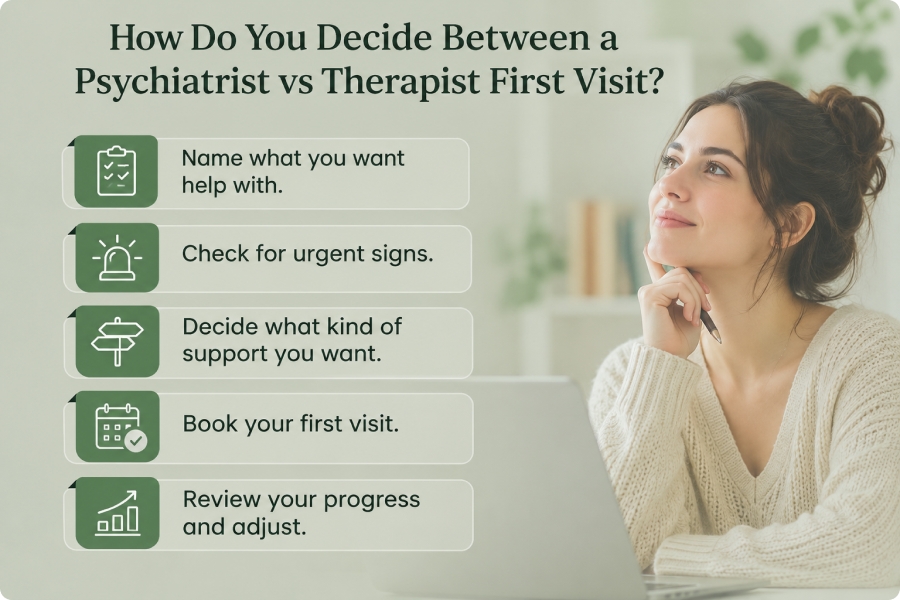
Use these five steps to choose between a psychiatrist or therapist for a first appointment. There’s no wrong door, and you can always add another provider later.
- Name what you want help with. Write down the concerns that bring you in, such as worry, low mood, trouble focusing, sleep problems or stress, and how long they’ve lasted.
- Check for urgent signs. If you’re thinking about suicide or feel unsafe, call or text 988 now. For immediate danger, call 911. Don’t wait for an appointment.
- Decide what kind of support you want. If you mainly want to talk and build skills, a therapist may be a good start. If you want medication evaluated or symptoms are hard to manage, a prescriber visit may be a good start.
- Book your first visit. Choose the starting point that fits and schedule it. If you’re unsure, ask the practice to help you decide when you call.
- Review your progress and adjust. Check in with your provider about how things are going. You can add therapy, add a medication evaluation or change providers as your needs change.
Signs a therapist may be a good first stop
- You want to talk through stress, grief, relationships or life changes.
- You want to learn coping skills for worry or low mood.
- You’d like to understand your patterns and build new habits.
Signs a prescriber may be a good first stop
- Symptoms affect sleep, work or daily life and have lasted.
- You already take medication and want it reviewed.
- You think medication may be useful and want an evaluation.
- You have a mix of physical and mental health concerns, and a primary care provider can help with the physical side.
|
Ready to choose a starting point? Our team at Mind & Body Wellness helps adults, teens and children begin with the type of visit that fits their needs, by secure video from home. |
Can You See Both a Therapist and a Prescriber?
Yes, and many people do. A therapist can focus on skills and support while a prescriber reviews medication. When both are in one practice, they can share notes with your written permission, which keeps your care consistent. At Mind & Body Wellness, you also see the same provider at each visit, so you don’t have to retell your story every time. That continuity can make care feel more personal.
If focus and attention are the main concern, an ADHD specialist in North Carolina or Florida visit with a prescriber is a common place to start. Our guide to an online ADHD evaluation for adults explains what to expect.
How a therapist and a prescriber can work together
Say your therapist notices that sleep trouble is making every other challenge harder. With your permission, the therapist can let your prescriber know, and the prescriber can review whether a medical approach fits. In turn, your prescriber can encourage you to keep going with therapy. That back-and-forth is what coordinated care looks like, and it means no single provider has to carry the whole plan alone.
Does seeing a prescriber mean you must take medication?
No. A first visit with a prescriber is an evaluation. Your provider asks about your symptoms, history and goals, then explains your options. You decide what feels right, and medication is only one possibility. Please don’t start, stop or change any medicine without talking to your prescriber.
A Made-Up Example: Choosing a First Appointment
This example is fictional and shows the process. It isn’t a real patient or a real case.
Consider Riley, who has felt anxious for months. Riley has trouble sleeping and finds it hard to focus at work. Riley isn’t sure whether to book therapy or a medication visit, so Riley calls the practice and describes what’s going on.
The staff explain the options, and Riley chooses an evaluation with a psychiatric nurse practitioner first. During the visit, the provider asks about sleep, worry and daily routines, then talks through a plan that may include therapy with a counselor. Riley leaves with a clear next step and knows more options are available if needs change. A month later, Riley and the provider might talk about adding weekly therapy or adjusting the plan. The first choice never has to be the final one, and asking questions along the way is always welcome.
|
Want help choosing between therapy and a medication visit? Our team at Mind & Body Wellness helps you understand your choices and next steps, with warmth and without pressure. |
What Should You Bring to a First Visit?
- A list of your symptoms and how long you’ve noticed them.
- A list of medications and supplements you take now.
- Your insurance card and photo ID.
- Notes about your health history and any past treatment.
- Questions you want to ask.
How Do Online Visits Work for Each Type of Provider?
Therapy and medication visits both happen by secure video. After you book, you complete intake forms by email, then connect at your appointment time from a phone, tablet or computer. Our new patient page explains the steps. Make sure your provider is licensed in your state during the visit, whether you’re in North Carolina or Florida.
Privacy matters in both cases. Mind & Body Wellness uses HIPAA-compliant secure video, and your health information is shared only as the law allows, and in most other cases only with your written consent. Choose a quiet space and use headphones if others are nearby.
What Should You Do If You Need Support Right Now?
A therapist or prescriber visit is for ongoing care, not emergencies. If you’re thinking about suicide or feel unsafe, call or text 988 to reach the 988 Suicide & Crisis Lifeline, available around the clock. If there’s immediate danger, call 911. For same-day support that isn’t an emergency, read about behavioral health urgent care.
Conclusion
The psychiatrist vs therapist choice doesn’t have to be stressful. Therapists teach skills and offer support, psychiatrists are medical doctors who can prescribe, and psychiatric nurse practitioners can assess, diagnose and manage medication. Start where you feel most ready, and know that you can add or change providers as your needs change.
Mind & Body Wellness brings therapy and medication management together in one fully virtual practice serving North Carolina and Florida. When you’re ready, get in touch with our team and we’ll help you find the right first visit.
This article is for educational purposes only and is not medical advice. It does not replace an evaluation by a licensed provider. If you are in crisis, call or text 988, or call 911 in an emergency.
FAQs
What is the difference between psychiatrist and therapist care?
Should I see a psychiatrist or a therapist first?
Can a psychiatric nurse practitioner prescribe medication?
Is a psychiatric nurse practitioner the same as a psychiatrist?
Can I see a therapist and a psychiatric nurse practitioner at the same time?
Do I need a referral to see a therapist or prescriber?
Are online visits private?
Read More About Mental Health Providers and Visits
- Online Anxiety Treatment: How Telehealth Psychiatric Care Works – how psychiatric care works by video
- What Happens During Your First Telehealth Therapy Session? – a walk through your first video visit
- What Is Behavioral Health Urgent Care and When Should You Use It? – when same-day support may be the right choice
Sources
- Types of Mental Health Professionals – NAMI (https://www.nami.org/treatments-and-approaches/types-of-mental-health-professionals/)
- What is Psychiatry? – American Psychiatric Association (https://www.psychiatry.org/patients-families/what-is-psychiatry/)
- How do I protect my data and privacy? – Telehealth.HHS.gov (https://telehealth.hhs.gov/patients/additional-resources/data-privacy)
- 988 Suicide & Crisis Lifeline – SAMHSA (https://www.samhsa.gov/mental-health/988)
