

Feeling nervous before a first therapy session is one of the most normal reactions there is. Most people booking their first online counseling session wonder some version of the same things: What will actually happen? What will I be asked? Do I need to prepare something in advance, or show up with a clear explanation already worked out?
Here’s the short version. A first telehealth therapy session is generally focused on getting to know you, understanding what’s bringing you in, and starting to talk about what you’d like to work on. It’s not a test, there’s no grade at the end, and there’s no way to do it wrong. You don’t need to have your thoughts perfectly organized before you log on. This guide walks through what to expect telehealth counseling looks like before, during, and after your first session, so you’re not walking in blind and wondering what comes next.
Your first telehealth therapy session typically involves an introduction, a discussion of confidentiality, and a conversation about what’s bringing you to therapy, including your current concerns, history, and goals. It generally runs longer than later sessions and ends with a general sense of what ongoing care might look like. No diagnosis or treatment plan is guaranteed on day one.
Key Takeaways
- A first session is mainly about introductions, confidentiality, and understanding what brought you to therapy
- You don’t need to prepare a polished explanation or share everything at once
- Diagnosis isn’t automatic in a first session; some situations take additional visits to become clear
- Therapist fit matters, and it’s normal to reassess after a session or two
- Mind & Body Wellness provides virtual mental health care across North Carolina and Florida, with most major insurance accepted
What Is a Telehealth Therapy Session?
A telehealth therapy session is a talk-based psychotherapy session conducted over secure video instead of in an office. A licensed therapist online runs the conversation the same way they would in person, covering your background, current concerns, and goals, with the same confidentiality and clinical standard as an in-office visit.
What Should You Do Before Your First Telehealth Therapy Session?
Choose a Private, Comfortable Space
Pick somewhere you won’t be interrupted or overheard, whether that’s a bedroom with the door closed, a parked car, or any spot where you can speak freely. Fewer distractions make it easier to actually engage in the conversation. A comfortable chair helps too, and headphones can be useful if privacy is limited in your home.
Check Your Technology
Make sure your internet connection, camera, and microphone are working ahead of time, ideally the day before rather than five minutes beforehand. Your video therapy appointment happens over a secure, HIPAA-compliant video visit, so joining a few minutes early gives you a buffer if anything needs adjusting. It also helps to know a backup way to reach your virtual therapist’s office in case of a technical problem during the session.
Think About Why You Are Seeking Therapy
Jot down a few thoughts on your main concerns, anything that’s changed recently, and what you’re hoping to get out of therapy. This isn’t a formal exercise. You don’t need a polished explanation or a complete history ready to go. A rough sense of why you’re here, even if it’s just “something feels off,” is more than enough to start with.
Read About More: Is Telehealth Therapy as Effective as In-Person Care?
What Happens During the Beginning of Your First Session?
The U.S. Department of Health and Human Services notes that telehealth for behavioral health care has become a widely used and accepted format for mental health services, with research generally finding it comparable to in-person therapy for many common concerns. That’s part of why the format itself isn’t something to worry about walking in.
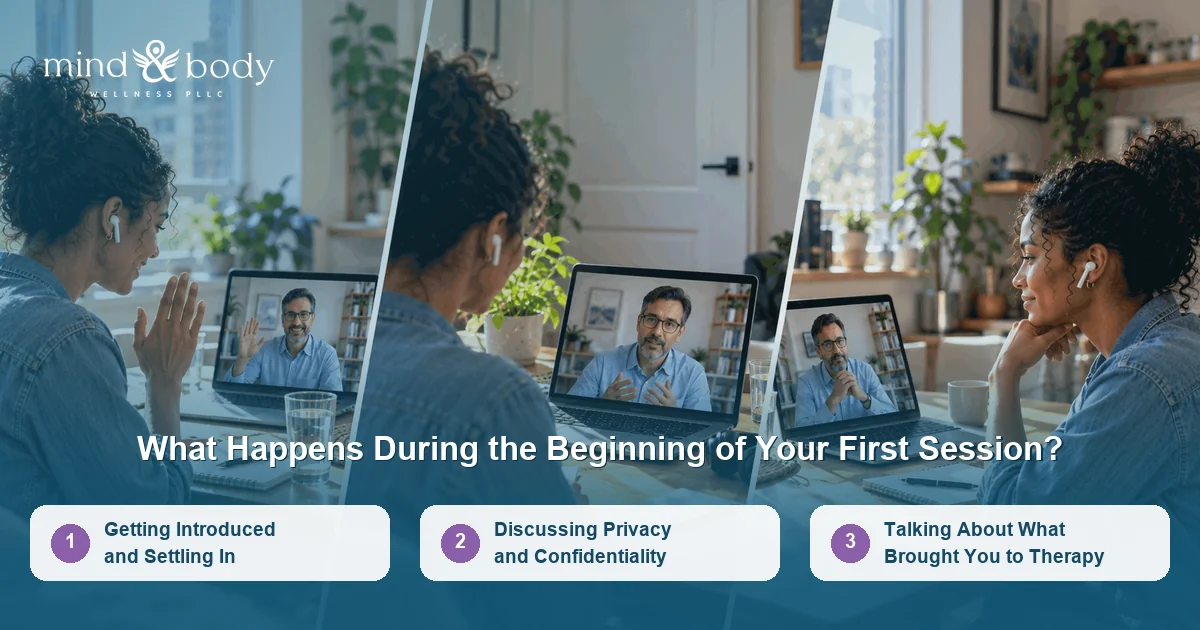
Getting Introduced and Settling In
Your therapist will introduce themselves and give you a general sense of how the session works, including how long it will run and what the general structure looks like. This is also a good moment to ask any initial questions you have, whether that’s about their background, their approach, or simply how telehealth sessions differ from in-person ones, before getting into the deeper conversation.
Discussing Privacy and Confidentiality
Your therapist will typically explain confidentiality in plain terms early on, including any relevant limits or exceptions required by law, such as situations involving safety concerns. This isn’t meant to be alarming. It’s a standard part of any first session, in person or online, and it’s meant to make sure you understand how your information is protected before you start sharing it. If anything about privacy is unclear, this is the right time to ask.
Talking About What Brought You to Therapy
From there, the conversation usually turns to your current concerns: what’s going on, when it started, and how it’s been affecting your daily life, whether that’s your work, sleep, relationships, or general sense of wellbeing. Some people arrive knowing exactly what prompted them to seek help now, whether that’s ongoing anxiety, symptoms of depression, or a specific recent change. Others just know something feels off without being able to name it more precisely. Both are completely reasonable starting points, and your therapist is used to working with either one.
What Questions Might a Therapist Ask During the First Session?
A first session generally touches on a handful of broad categories rather than a rigid checklist read aloud:
- Your current symptoms or concerns, and how long you’ve been experiencing them
- Your emotional and mental health history, including anything you’ve dealt with in the past
- Daily routines and how you’re functioning day to day, from sleep to work to basic tasks
- Relationships and who’s part of your support system, including family and friends
- Any previous therapy or treatment, including medication you’ve tried before
- What you’re hoping therapy will help with, even if that’s still a little vague right now
You won’t necessarily have a clear answer to every question, and that’s completely fine. You don’t need to tell your entire life story in one sitting, and you can always let your therapist know when a topic feels difficult to talk about yet. A good first session moves at a pace that works for you, not a predetermined script your therapist is racing through.
Will You Be Diagnosed During Your First Telehealth Therapy Session?
Not automatically, and not in every case. A first session often involves assessment and information gathering rather than an immediate diagnosis handed down at the end of the hour. Some situations become clearer after one conversation, especially when symptoms are well-defined and consistent with something your therapist has seen many times before. Others take a session or two of additional context before a clearer picture forms, particularly when several concerns are overlapping. This varies by provider and by what you’re bringing into the room, so it’s worth asking your therapist directly what their general approach looks like and whether a diagnosis is even something you need right away.
Do You Have to Talk About Everything in Your First Session?
No. You don’t need to cover everything in one appointment, and trying to fit your entire history into a single hour usually isn’t realistic anyway. Share what feels relevant and manageable right now, and let your therapist know if you need to slow down or come back to something later once you’ve built more trust. Therapy generally develops over multiple sessions, not a single conversation, and building comfort with your therapist is part of that process itself, not something you’re expected to arrive with already in place before you even start.
What Happens at the End of Your First Telehealth Therapy Session?
Toward the end, your therapist will usually summarize the main concerns you’ve discussed and talk through general goals for therapy going forward. That might include a possible treatment approach, whether that’s ongoing talk therapy, a referral, or coordination with a medical provider, along with a sense of next steps and when you’ll meet again.
This is also a good point to ask questions of your own, such as:
- What can I expect in future sessions?
- How often should we meet?
- How will we work toward my goals?
- What should I do between sessions?
Asking these directly, rather than guessing, helps you leave the first session with a clearer sense of what happens next instead of wondering.
How Might You Feel After Your First Telehealth Therapy Session?
Reactions vary quite a bit from person to person, and there’s no single expected response. Some people feel relief just from having said things out loud for the first time. Others feel hopeful, emotionally tired, uncertain, or like they have a lot to sit with afterward, especially if the conversation touched on something they hadn’t talked about before. All of these are normal responses, and there’s no single “right” way to feel walking away from a first session. It’s also completely fine if you don’t feel noticeably different yet. That’s not a sign anything went wrong or that therapy isn’t working.
What If You Don’t Feel Comfortable With Your Therapist?
Fit matters in therapy, and one session doesn’t always tell you everything you need to know about whether a therapist is right for you. If something feels off, whether it’s their communication style or just a general sense of mismatch, it’s worth naming that and asking your virtual therapist about their general approach before deciding anything final. If the fit still doesn’t feel right after giving it a fair chance, usually a session or two, looking into a different provider is a completely reasonable next step, not a failure on your part or a sign that therapy itself isn’t working for you.
It’s also worth mentioning: not every concern is best addressed in a routine weekly session. If attention, focus, or organization turns out to be a bigger factor than mood, an adult ADHD evaluation may be a better starting point, and that’s something reasonable to bring up with your therapist directly. And if something needs same-day attention rather than a scheduled appointment, behavioral health urgent care is the more appropriate first step among our telemedicine services.
|
Ready to find the right therapist for you? Every situation is different, and we’ll help you find the right starting point. |
First Telehealth Therapy Session Checklist
If you’re wondering what to expect telehealth counseling to look like on a practical level, this checklist covers the basics for your online therapy first session.
Before your session: a private space, reliable internet, your camera and microphone checked ahead of time, water or tissues nearby, and a few rough thoughts on what you want help with.
During your session: ask the questions you came with, share what feels relevant without forcing yourself to cover everything, speak up if something feels uncomfortable, and talk through goals and next steps together.
After your session: take a few minutes to reflect on how it went, jot down any questions that came up for next time, and decide whether you’d like to schedule another session.
What to Expect From Your Next Telehealth Therapy Session
Later sessions generally build on what you covered in your first one, with a more specific focus on your goals and treatment approach. Therapy tends to develop gradually rather than getting resolved in a single appointment, and that’s by design, not a shortcoming of the process.
Mind & Body Wellness provides telehealth counseling across North Carolina and Florida, with most major insurance accepted. Whether you’re specifically searching for online therapy for depression, looking into depression treatment online, or trying to figure out whether therapy should be coordinated with virtual primary care, our team is happy to talk it through with you before you book anything. If you’re in North Carolina or Florida and searching for a therapist North Carolina residents can actually get scheduled with, or checking telehealth Florida availability, both pages walk through what’s covered.
FAQs
What happens during your first telehealth therapy session?
Your therapist introduces themselves, explains confidentiality, and asks about what’s bringing you in. It’s generally focused on understanding your concerns and starting to talk about your goals.
How long is a first telehealth therapy session?
First sessions typically run longer than follow-ups, since there’s more background to cover. Your therapist will let you know the expected length when you book.
What questions will a therapist ask during the first session?
Expect questions about your current concerns, mental health history, daily functioning, relationships, prior treatment, and what you’re hoping therapy will help with.
Do I need to prepare anything before online therapy?
Not much. A quiet, private space and a working internet connection are the main things. Jotting down a few thoughts on why you’re seeking help can help, but isn’t required.
Do I have to talk about everything in my first therapy session?
No. Share what feels manageable, and let your therapist know if you need to slow down. Therapy develops gradually across multiple sessions.
Will my therapist diagnose me during the first session?
Not always. Some situations become clear quickly, while others take additional sessions of context. This varies by provider and by your specific situation.
What should I do if I don’t know what to say?
Tell your therapist exactly that. Not knowing where to start is common, and a good therapist can help guide the conversation from there.
